Environment Creation Issues
Problem
Failed to create an environment due to the following error:
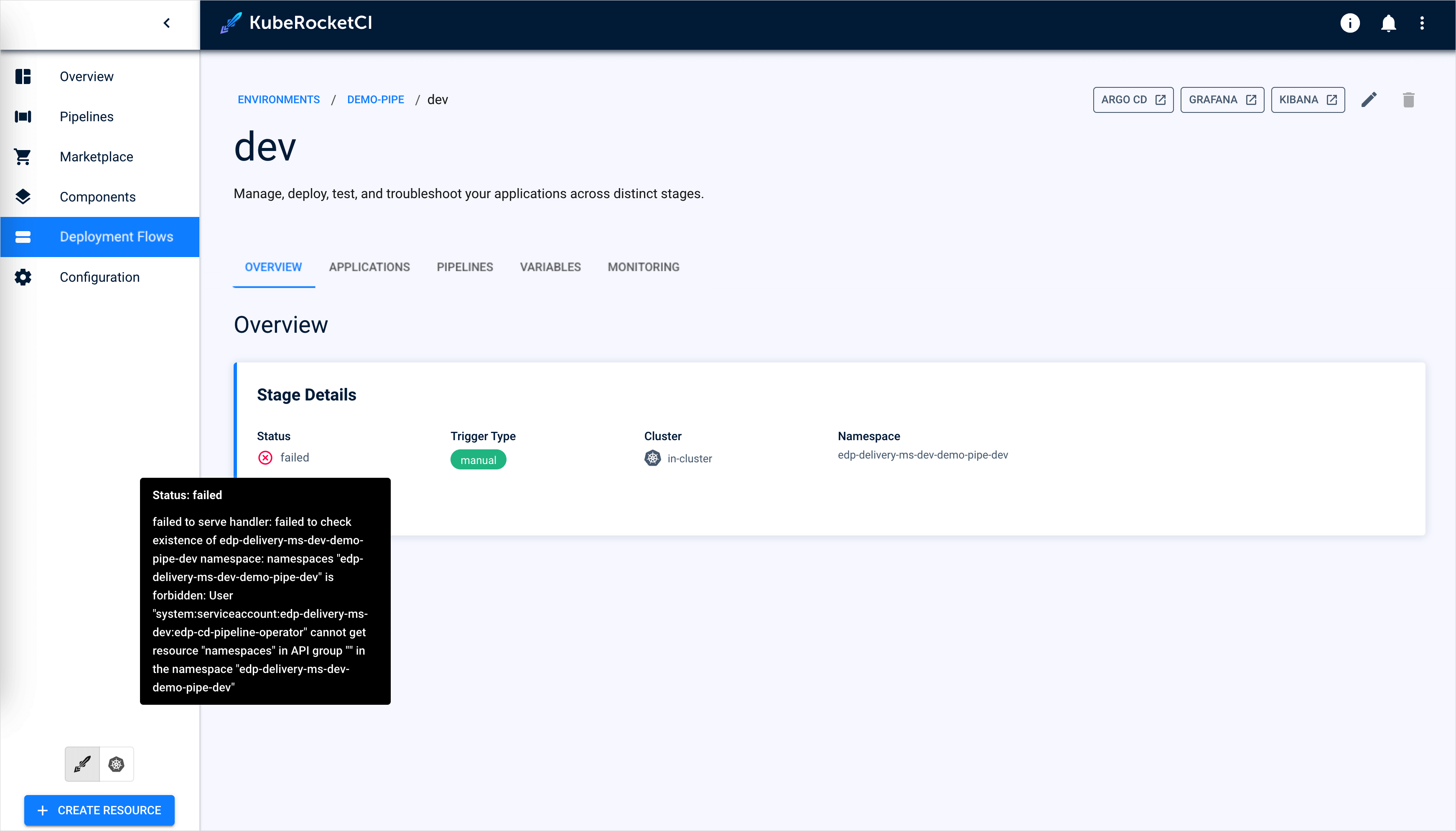
Cause
KubeRocketCI offers several approaches for namespace management: namespaces can be created by users, by KubeRocketCI itself, or by Argo CD. With the default settings on Kubernetes, a namespace that users or Argo CD create before its Environment needs a label (see Environment Fails in a Namespace Without the Tenant Label). If you expect KubeRocketCI to handle namespace creation, ensure that the cd-pipeline-operator, a component of KubeRocketCI, has the necessary permissions. This permission is managed by the manageNamespace parameter of the values.yaml file.
If the manageNamespace parameter is set to false, it means the KubeRocketCI does not have permission to create namespaces and the procedure of creating namespaces in your project is delegated to a concrete person.
Solution
Make sure the manageNamespace parameter is intentionally set to false. If not, define proper flow for namespace management. Read the Namespace Management page for more details.
If the parameter was intentionally set to false, the solution would be to clarify with your management who is allowed to manage namespaces in your project and request a namespace creation:
If you are allowed to create namespaces, create it manually:
-
Open the terminal. Ensure you have access to the cluster from your kubeconfig.
-
Create a namespace using the
kubectl create namespacecommand:
kubectl create namespace <ns>
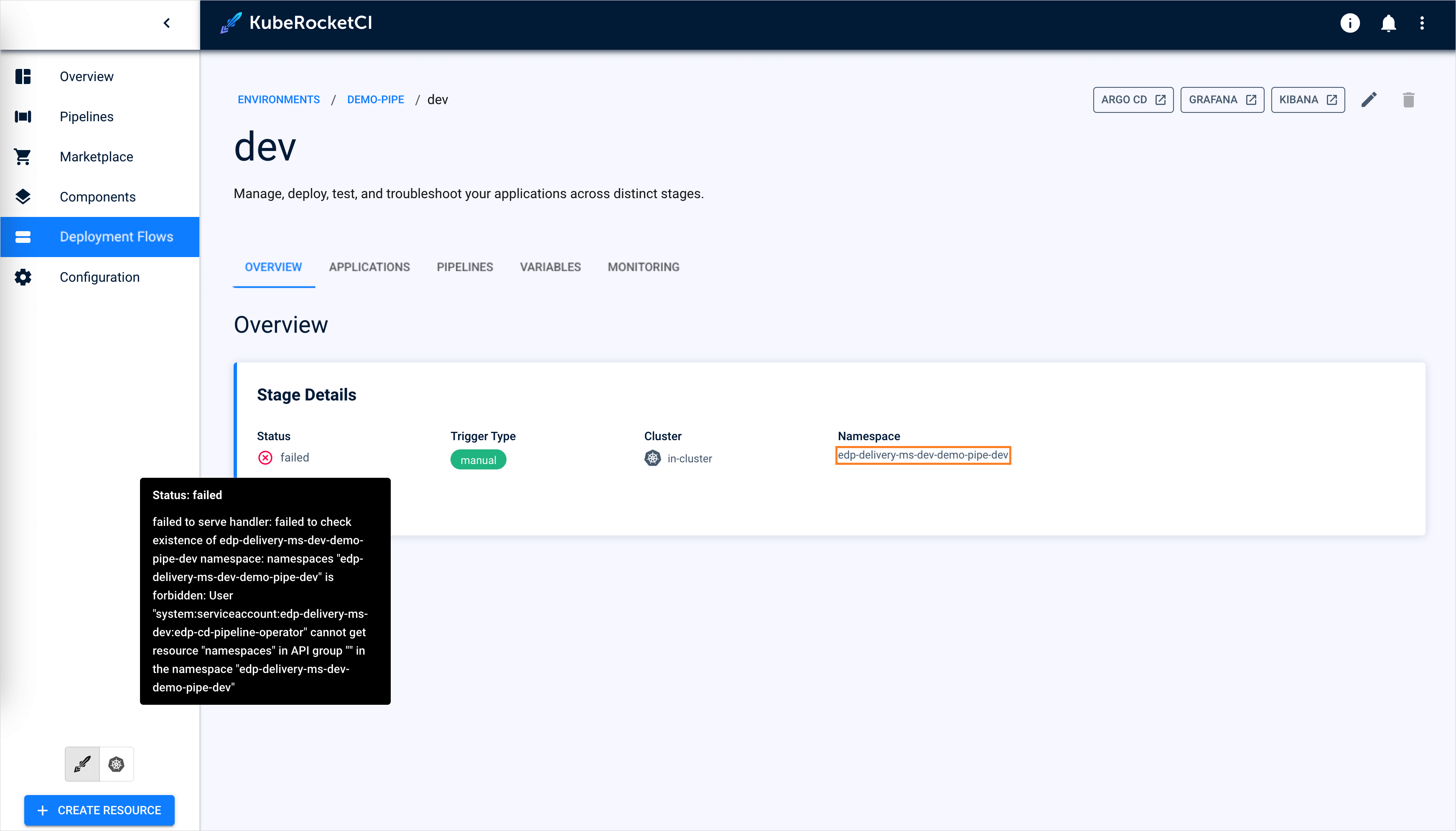
Usually, the required namespace is shown on the Overview tab of the Environment:
Environment Fails in a Namespace Without the Tenant Label
Problem: since KubeRocketCI 3.16, an Environment in a namespace that was created before it shows the following message, or deleting the Environment or its Deployment does not finish:
... denied request: edp-cd-pipeline-operator may act only on its own namespace and namespaces it provisioned (label app.edp.epam.com/tenant).
Cause: with the default settings on Kubernetes (tenancyEngine: none, manageNamespace: true), an admission policy lets the cd-pipeline-operator configure and delete only namespaces labelled app.edp.epam.com/tenant. The operator labels the namespaces it creates, but not a namespace created before its Environment, for example by a user or Argo CD.
Solution: label the namespace with the name of the platform namespace, as the operator does; it then retries the Environment on its own.
Label only a namespace that holds nothing but this Environment: when the Environment is deleted, the operator deletes the labelled namespace with everything in it.
kubectl label namespace <environment-namespace> app.edp.epam.com/tenant=<platform-namespace>
To find all affected namespaces, see Upgrade KubeRocketCI v3.15 to 3.16.